




























What if Death came to your door not bearing a scythe, but as a black dog — and turned out to be rather good company? That’s the moving, melancholy premise at the centre of Cassandra Khaw’s latest novel, Find Me Where It Ends which released this week.
The story follows Antigone, who is no stranger to death. For the women in her family, it has always arrived as a black dog, and when her own spectral companion finally appears, she welcomes it inside.
What begins as an unsettling encounter gradually becomes something much more intimate, as Antigone is forced to reckon with the life she’s lived, the parts of herself she has hollowed out for others and the bone-deep exhaustion that has followed her through it.
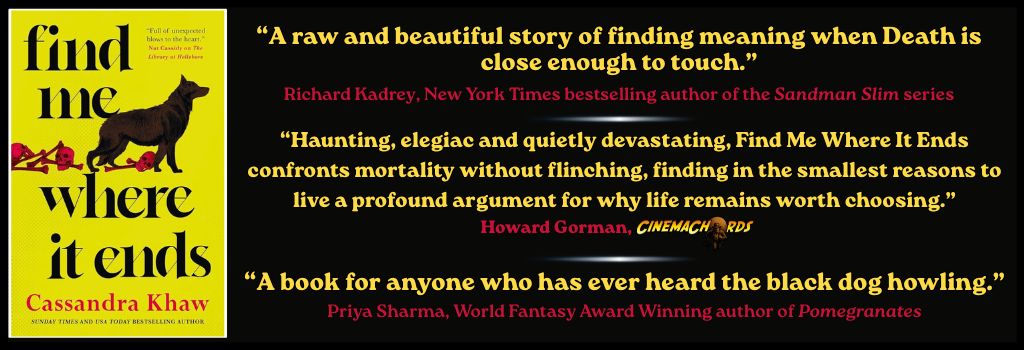
Find Me Where It Ends makes a strange companion of Death, turning the black dog at Antigone’s door into something less like a harbinger than a confidant. And Khaw’s real sleight of hand comes in the form of making survival feel tangible: not some grand revelation, but rather an amalgamated accumulation of people, memories and tiny reasons to keep going.
 ADD TO GOODREADS
To celebrate the book’s release this week, CinemaChords sat down with Khaw to discuss the folklore and symbolism behind the novel’s central black dog, the complex relationship between mortality and the people and connections that give life its meaning, and the role her lexical-gustatory synaesthesia plays in shaping her prose. We also discuss why Find Me Where It Ends is one of the most vital books published this year, irrespective of genre, offering a powerful and profound reminder that even the smallest things in life can provide the strongest reasons to stay.