
































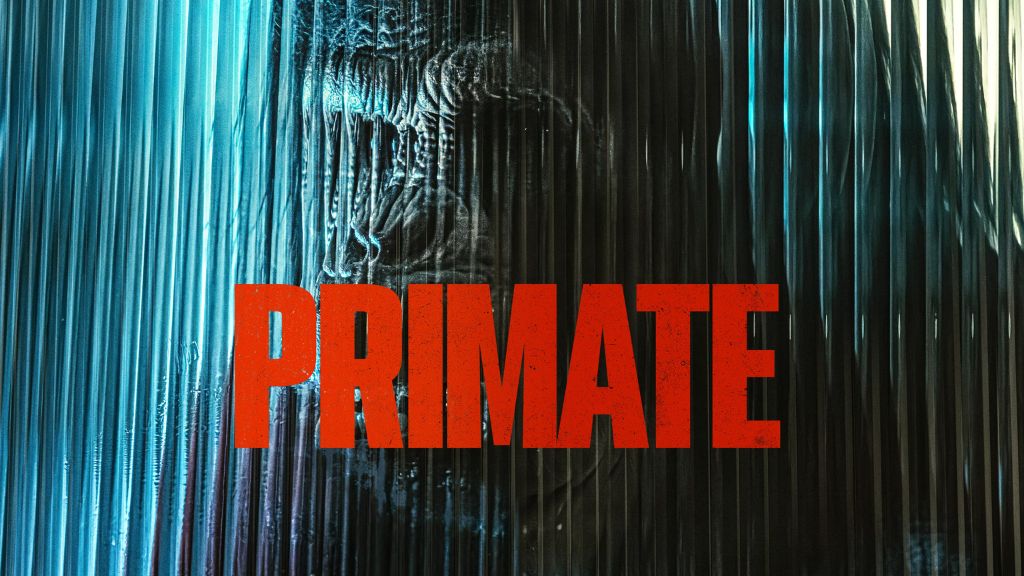
Contained, claustrophobic thrillers have long been a recurring feature of Johannes Roberts’ (47 Meters Down, Storage 24) work, with pressure, proximity, and survival often doing as much of the heavy lifting as spectacle. His latest film, Primate, continues this approach, using a familiar domestic setting to explore how quickly tension can escalate when escape is limited.
Set largely within a single house, the film centres on Lucy (Johnny Sequoyah – “Dexter: New Blood”), a teenager who comes home for the holidays expecting little more than an uneasy family reunion. When her father (Troy Kotsur – CODA) is abruptly called away, Lucy is left with her sister and the family’s chimpanzee, Ben. A small gathering of friends initially brings a sense of normality, but the familiar environment soon becomes increasingly hostile, forcing the characters to confront a threat that leaves no clear path to escape. True to Roberts’ style, the danger is shaped as much by confinement and timing as it is by the creature itself.
Following a strong festival run, Primate opened in US theatres earlier this month and will arrive in UK cinemas on January 30.
Ahead of the film’s UK release, CinemaChords spoke with Johannes Roberts about returning to a straight-up creature feature, his approach to incrementally building tension – which he likens to sequencing an album’s tracklist – how character relationships help sharpen that sense of threat, and how a reliance on practical effects ultimately won over initially sceptical producers.